
Lumens, Watts And Lux
LED headlight lumens describe light output; watts describe electrical input; lux describes the light reaching a surface. Compare all three using the same product variant and test conditions. A larger wattage label alone cannot tell a buyer which headlight will illuminate the required area better.
| Quantity | Unit | What to ask the supplier |
|---|---|---|
| Luminous flux | Lumen (lm) | Is this measured output from a complete bulb, a pair, or an LED component? |
| Electrical input power | Watt (W) | At what supply voltage, operating time and configuration was power measured? |
| Illuminance | Lux (lx) | At what distance, aim and measurement points, using which headlamp? |
CIE’s luminous-flux definition identifies the lumen as the unit of luminous flux. CIE’s illuminance definition describes light incident on an area and uses lux, equivalent to lumens per square metre. For a purchasing comparison, record source output separately from the beam measurement in the assembled headlamp.
Per Bulb Or Per Pair?
Normalize the reporting basis before ranking two lumen claims. Ask the supplier to state “per complete bulb” or “per pair” next to every power and light-output figure. Also identify low-beam and high-beam operating modes where the product has both functions.
Consider an illustrative quotation: Supplier A lists 16,000 lm per pair, while Supplier B lists 9,000 lm per bulb. If the pair contains two equal-output bulbs, A corresponds to 8,000 lm per bulb. B has the larger stated per-bulb figure, although 16,000 looked larger on the original quotation.
This is a calculation example, not measured performance data for RCJLED products. It establishes a common reporting basis; equivalent testing and beam results still need to be checked.
Request a complete-product measurement. Adding the nominal output ratings of individual LED chips does not provide the same evidence as measuring the finished bulb with its actual driver, temperature and operating configuration. Keep the original report beside the normalized comparison so the commercial summary remains traceable.
Initial Vs Stabilized Output
Record how output changes during operation, not only the first bright reading. A useful sample record includes elapsed time, electrical input and optical output. Keep ambient temperature, airflow, mounting and supply conditions alongside the readings.
The IES LM-79-24 overview covers reproducible optical and electrical measurements for solid-state lighting. Its published contents include temperature, airflow, mounting conditions, electrical settings, pre-burn and stabilization. These are useful topics to ask a laboratory or supplier to document.
For your sample acceptance, agree a measurement schedule and a defined stabilization criterion before testing. Do not treat an arbitrary elapsed time as proof of stabilization. If one report uses a bare bulb with free airflow and another uses an installed lamp behind its rear cover, record them as different test configurations.
Use the same timing basis when comparing products. An initial reading for one bulb and a later reading for another cannot isolate the effect of product design. A formal test-method claim should name the method and identify the report; this guide does not assert that every RCJLED model has an LM-79 report.
Cooling In The Real Installation
Evaluate the cooling design inside the installation you intend to sell. A fan, a metal heat sink or braided cooling strips are starting points for inspection. Their presence alone does not establish the completed system’s operating temperature or sustained output.
The U.S. Department of Energy’s LED thermal-management guidance explains that LED temperature affects output and longevity, and that heat sinking and airflow must be considered together. Its examples concern general lighting; the transferable principle here is to evaluate the thermal conditions of the actual assembly.
On the sample record, note rear-cap closure, available clearance, driver placement, cable routing and the cooling structure’s installation position. For a fan-cooled version, record operation and noise. For a fanless version, record how the cooling surfaces are arranged and the space around them.
Retest after the assembly is completed. A sample that performs with the cover removed may face different conditions when installed as supplied. Use the same mounting arrangement for repeat comparisons, and retain photographs with the approved sample.
A Sample-Test Checklist
Use one acceptance sheet for every candidate bulb. The following is RCJLED’s recommended purchasing record, not a substitute for an accredited laboratory method or an automotive approval test.
- Identify the sample. Record supplier, exact model, socket, colour-temperature option, batch or sample reference, and required light function.
- Define the electrical setup. Record supply voltage, wiring, current and measured input power. Keep initial and later readings distinct.
- Define the environment. Record ambient temperature, mounting, airflow, cap position and any cooling accessories.
- Request optical evidence. Ask for the instrument or laboratory, calibration information, measured quantity, reporting basis and uncertainty where provided. A sphere measurement of total flux and a beam measurement answer different questions.
- Compare during operation. Use the agreed timing schedule, record the stabilization criterion and retain the output trend rather than only one selected value.
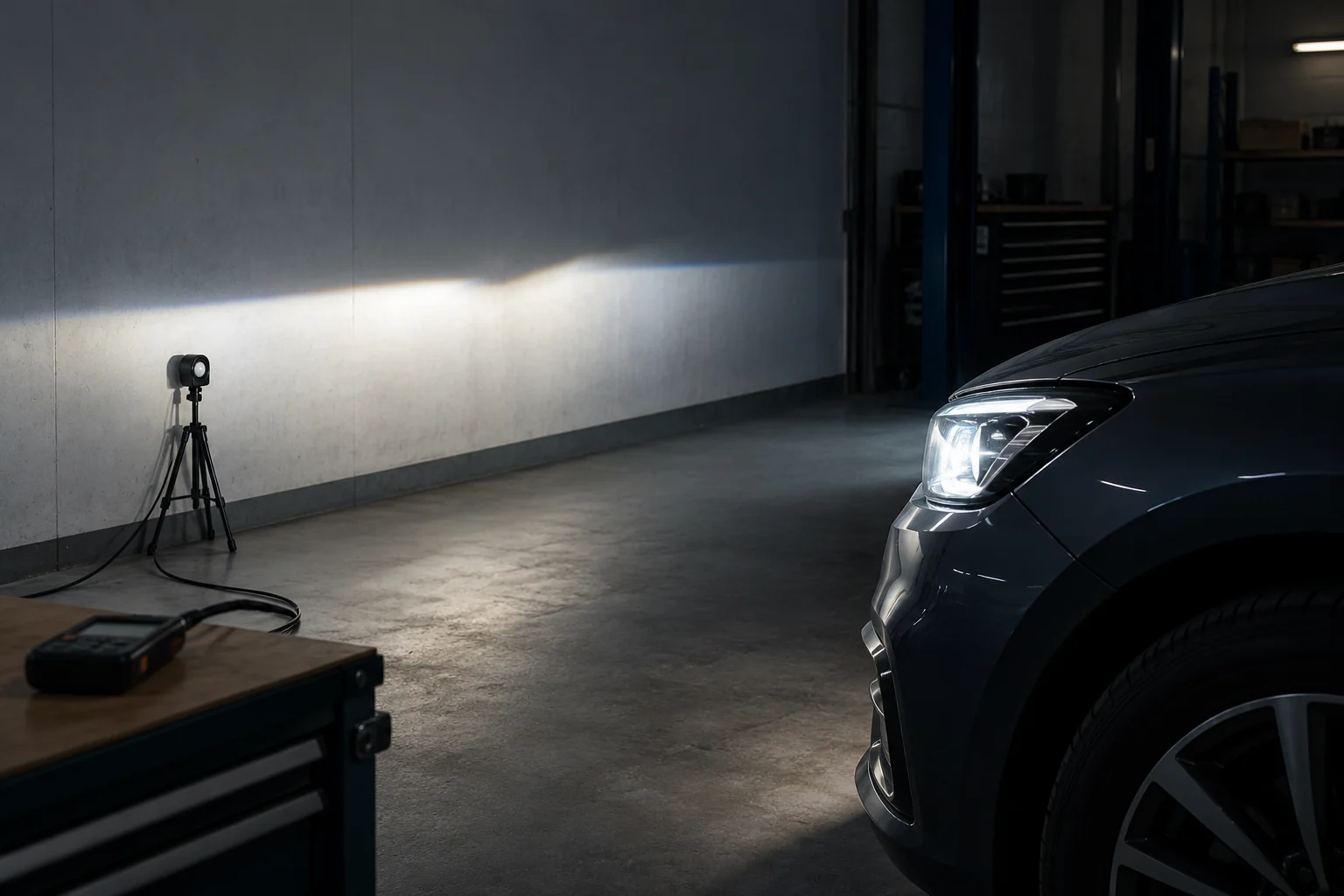
- Check the assembled beam. Record headlamp identity, aim, measurement distance and the same measurement points for every candidate. Keep exposure settings consistent if photographs accompany the record.
- Close the purchasing decision. Agree the acceptable configuration, supporting documents, repeat-order reference and written warranty terms before bulk production.
Keep fitment, electrical behaviour, optical results and commercial terms as separate acceptance fields. For vehicle and holder details, use our headlight socket and fitment guide.
Warranty And Lifespan Claims
A warranty period and a claimed operating life describe different things. Request both in writing for the exact model. An hours figure without its test basis is not enough to establish how a complete headlight system will perform in your application.
For a lifespan claim, ask what was evaluated: the LED component, driver, fan or complete bulb. Record the operating temperature, duty cycle, failure criterion and whether the figure is a test result or a projection. An LED-component maintenance result should not be presented as a measured lifetime for the complete bulb.
For warranty, confirm the start date, covered failures, exclusions, evidence required, claim procedure and remedy. Ask whether replacement freight and installation labour are included. Keep these commercial terms separate from your optical acceptance sheet.
For repeat orders, confirm that the approved configuration remains the same. Changes to the driver, LED source, fan or mechanical parts should trigger a specification review rather than silently inheriting an earlier sample’s results.
Compare RCJLED Models
Start with a shortlist, then request comparable evidence for the chosen variants. The model names below are catalog references, not verified comparisons of luminous output.
- JC 100W LED Headlight: a starting point for buyers exploring RCJLED’s original JC design. Specify the socket and requested test conditions with the inquiry.
- JC 65W LED Headlight: a separate JC model for a side-by-side sample discussion. Confirm the complete-bulb power and output basis rather than inferring performance from the family name.
- S8 55W Fanless LED Headlight: an option for reviewing a fanless configuration. Check cooling-strip arrangement and available installation space with the actual sample.
Send the model links, socket quantities, target application and required documentation to Sales. For a private-label range, add your packaging, label and sample-approval requirements to an OEM / ODM project brief. Our seven-question sourcing checklist covers the wider supplier conversation.
Buyer Questions, Answered
Is a 100W LED headlight always brighter than a 65W model?
No. Wattage describes electrical input, while lumens describe light output. Compare complete-bulb measurements on the same per-bulb or per-pair basis, under equivalent conditions, then check the beam in the intended headlamp.
How many lumens should I look for in an LED headlight?
There is no single purchasing target that can be chosen from a lumen number alone. Define the vehicle application and beam requirements, then evaluate the exact bulb and headlamp together. Ask for a traceable optical report and sample results.
Can I convert lux into lumens from one measurement?
One lux reading at one point does not establish the complete source’s luminous flux. Record the measurement geometry and beam distribution. Use the appropriate measurement method for the quantity you want to compare.
Are fanless LED headlights better than fan-cooled bulbs?
The cooling category alone does not decide the result. Compare sustained operation, installation space, airflow, noise where relevant and the completed sample’s performance under the same conditions.
Does a lifespan claim equal the warranty period?
No. Ask separately for the basis of the operating-life claim and the written warranty coverage. Identify the tested component or complete product, operating conditions, covered failures and claim procedure.
What should I send RCJLED for a useful quotation?
Send the product link, required socket and light function, target application, quantity, test conditions, per-bulb reporting requirements and needed documentation. Include branding and packaging preferences for an OEM / ODM project.
Sources And Method Notes
The definitions and general measurement principles above draw on the following primary sources, checked October 18, 2026. The sample checklist, quotation example and buying recommendations are RCJLED editorial guidance. No numerical example is a claimed RCJLED laboratory result.
- CIE e-ILV: luminous flux — International Commission on Illumination.
- CIE e-ILV: illuminance — International Commission on Illumination.
- ANSI/IES LM-79-24: optical and electrical measurements — Illuminating Engineering Society.
- LED Outdoor Area Lighting Fact Sheet — U.S. Department of Energy.